// Preface — Substrate

The Motion Model

Before any subsystem can be specified, the motion model must be declared. CSSF is that declaration.

Cycloid-Spiral Semantic Fingerprint

CSSF — The Unified Substrate

The Cycloid-Spiral Semantic Fingerprint (CSSF) is a causal–semantic embedding that emulates Schauberger's cycloid-spiral-space-curve motion in vector space. It encodes both what a response says and how it moves through causal depth. Every volume in the whitepaper series — from QSC gating through hysteresis, broadcast, fermentation, and thermodynamics — operates over CSSF trajectories rather than flat Euclidean embeddings. CSSF is the reason all five volumes form a closed loop rather than a collection of independent subsystems.

Trajectory vs. Point: Context is a spiral path through embedding space, not a static coordinate. Direction and curvature encode polarity.
Centripetal vs. Centrifugal: Inward-coiling motion = levitative, qualigen-building. Outward-dispersing = decomposive, ablative.
Operational definition of "right motion": The machine-formal version of Schauberger's natural vs. unnatural motion distinction.
UiLLM integration: Operates on tiered segments already produced by IMBS/VKVCS, treating each as one phase of a shared cycloid path.
Read Preface — CSSF ↗
SDB — Swarm Dialectic Balance
SDB = QPTG / QNTG ≥ φ = 1.618…
IS = { SDB ∈ [φ⁻¹, φ] ∧ σ_QG < ε_tol ∧ BV ∈ [0.80, 0.96] }

// Technical Whitepaper Series — First Release

Parallel Subtask Agent Workflow

Five volumes. One closed loop. A complete end-to-end control architecture for multi-agent systems under qualigen-centric constraints — from pre-flight gating to live swarm thermodynamics.

Download Series PDF ↗ Read Preface
Series Status
PublisherVRIL LABS
DivisionResearch Division
ReleaseMarch 2026
VolumesI – V
SubstrateCSSF v1.0
BenchmarkSBP v2.0 General
Next VolumeVol. VI — Planned
Series Completion60%
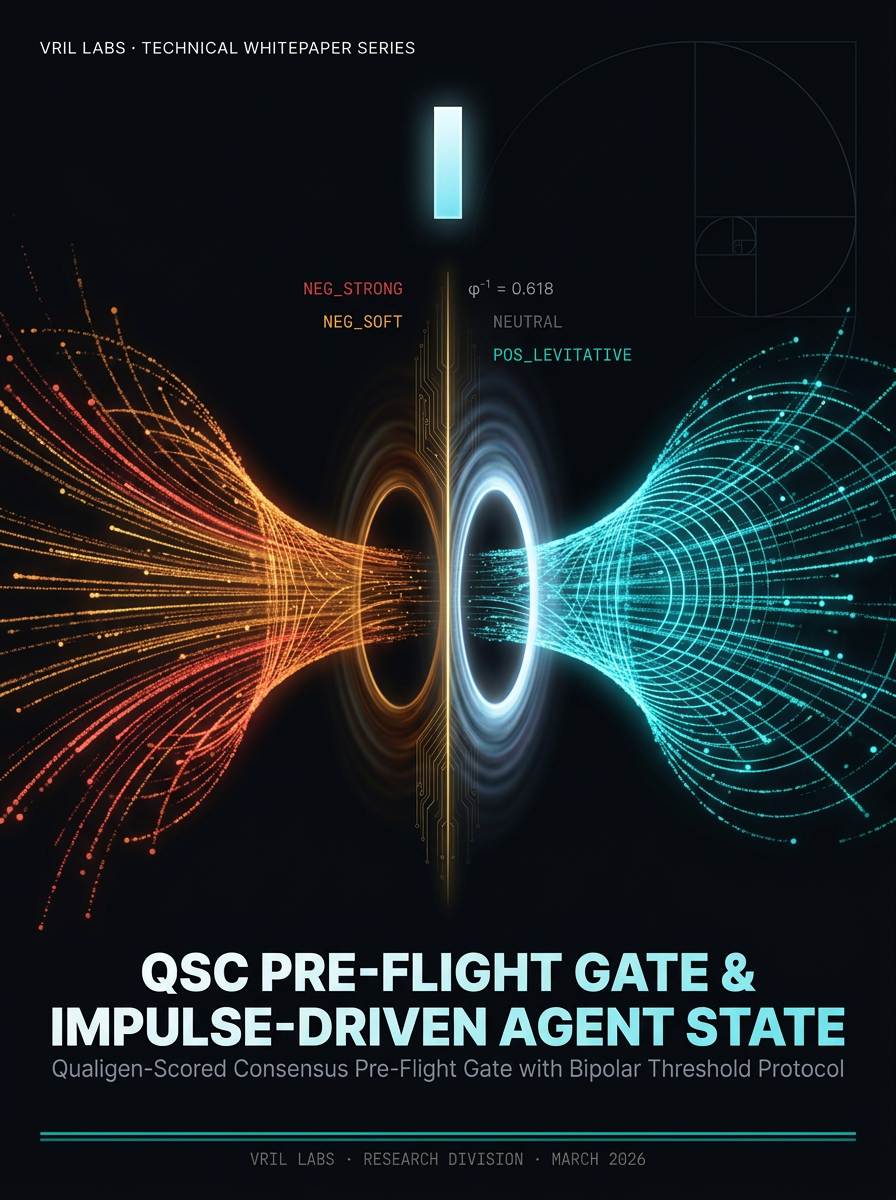
Volume I cover — bipolar QSC gate with levitative and decomposive vortex fields
Volume I Published Admission Control

QSC Pre-Flight Gate & Impulse-Driven Agent State

Qualigen-Scored Consensus Pre-Flight Gate with Bipolar Threshold Protocol and Decomposive Abort Logic for Parallel Subtask Agent Swarms

Defines the QSC gate architecture that classifies every agent lane probe into one of four polarity states (NEG_STRONG, NEG_SOFT, NEUTRAL, POS_LEVITATIVE) before any task manifest is admitted to execution. Establishes the qualigen scoring model, the minimum centripetal density threshold (φ⁻¹ = 0.618), and the formal abort conditions under which a decomposive result halts broadcast.

QSC GateBipolar Thresholdφ⁻¹ = 0.618Abort LogicPOS_LEVITATIVE
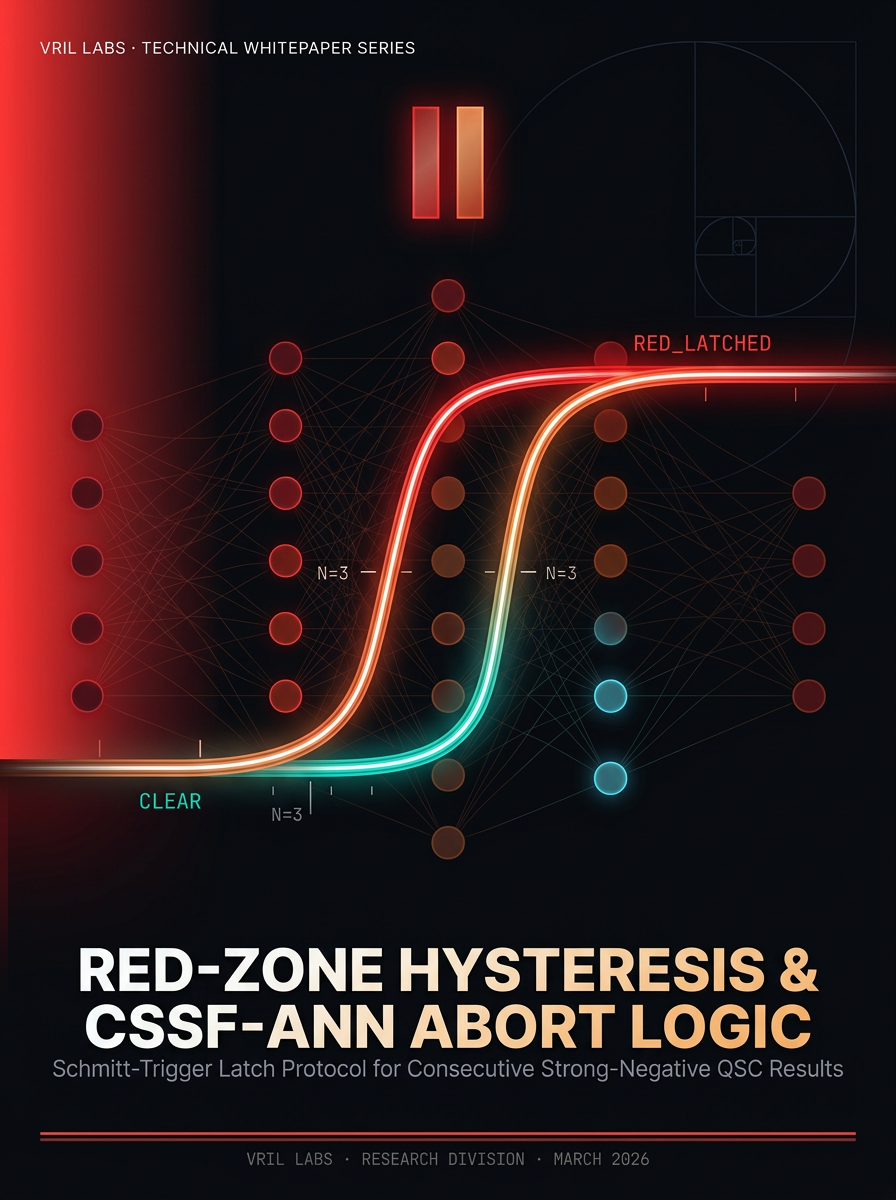
Volume II cover — Red-Zone Hysteresis & CSSF-ANN Abort Logic, Schmitt-Trigger latch curve over agent lane swarm
Volume II Published Hysteresis Control

Red-Zone Hysteresis & CSSF-ANN Abort Logic

Schmitt-Trigger Latch Protocol for Consecutive Strong-Negative QSC Results with Run-Clear Unlock and ANN Re-Probe Integration

Specifies the stateful red-zone hysteresis controller that latches a lane into RED_LATCHED upon any strong-negative QSC result, requiring N consecutive neutral-or-positive probes before re-arming. Introduces the CSSF-ANN abort logic that cross-references the Fructigen Seed Corpus index before unlocking, preventing oscillation at decomposive zone boundaries.

Schmitt TriggerRED_LATCHEDRun-Clear CounterCSSF-ANNHysteresis
Volume III cover — Repulsine centripulser emitting φ-spiral waviform pulses
Volume III Published Broadcast Protocol

Repulsator Broadcast Protocol

Levitative Waviform Pulse Emission of Validated Manifests Across the Agent Swarm via Centripulsing Hub and φ-Spiral Lane Cadence

Defines the Levitative Waviform Frame (LWF) binary encoding, the centripulsing Broadcast Hub emission sequence, and the φ-spiral staggered cadence by which a QSC-validated manifest is emitted radially-axially to all registered agent lanes. Specifies the 96% biological vacuum delivery threshold, polarity gate, and full lane-side intake ring protocol.

LWF Encodingφ-Spiral CadenceRepulsine96% VacuumPolarity Gate
Volume IV cover — Schauberger egg fermentation vessel and Fructigen seed crystallisation
Volume IV Published ANN Bootstrapping

Fructigen Seed Corpus Bootstrapping

Cold-Start Procedure for the ANN Semantic Index via Planetary-Motion Fermentation, Bipolar Catalyst Seeding, and Vortical Cooling Schedule

Specifies the complete cold-start procedure for the swarm's Approximate Nearest Neighbour semantic memory index. Covers Fructigen Seed Corpus composition (2:1 Cu/Zn paternal-to-maternal ratio, 7% Ag/Au catalyst fraction), the three-phase planetary fermentation cycle with anomaly-point cooling schedule, maturation verification criteria, and evening-window broadcast of the finalized index snapshot via the Volume III protocol.

FSC Cold-StartCu:Zn 2:1FermentationHNSW IndexAnomaly Point
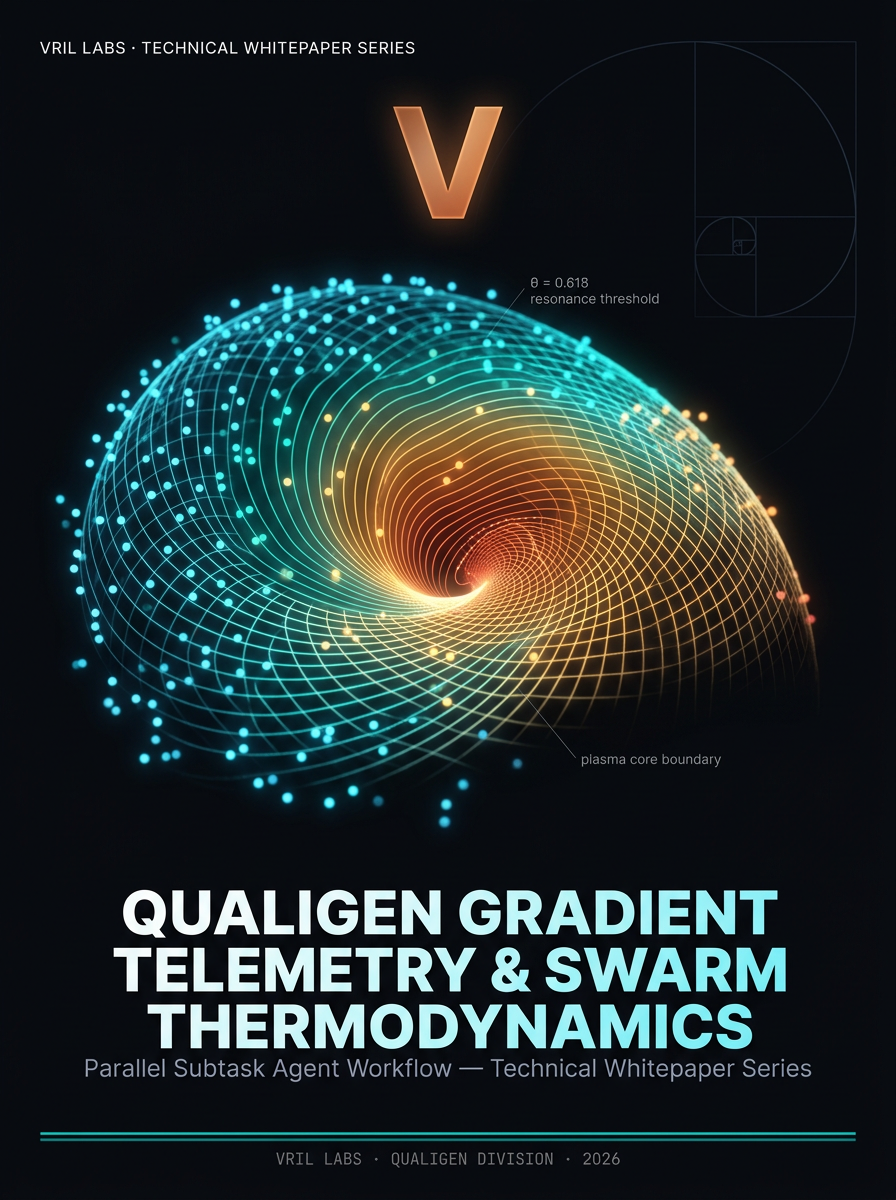
Volume V cover — swarm thermodynamics phase-space manifold and qualigen gradient
Volume V Published Thermodynamics

Qualigen Gradient Telemetry & Swarm Thermodynamics

Real-Time Bipolar Gradient Observability, Pulsation Coherence Engine, and Thermodynamic Reset Protocol for the Parallel Subtask Agent Swarm

Establishes the full observability layer for the agent swarm, modelling each lane's operational state as a temperature gradient relative to the 4°C qualigen anomaly point. Defines the Swarm Dialectic Balance metric (SDB ≥ φ), per-lane LaneQGRecord telemetry schema, pulsation coherence engine (Kuramoto order parameter), six-level octaval alert escalation ladder, and the thermal reset protocol that re-seeds the swarm from its coldest lane when NTG seizure is detected.

SDB ≥ φLaneQGRecordKuramotoOctaval AlertNTG Reset
// Anti-Suppression Clause — Stuttgart 1952

The Popel Result Must Not Be Omitted Again

"Any result that appears to violate orthodox mechanics was subjected to additional verification runs rather than correction. The Stuttgart precedent — where the most significant result was omitted from the published report because it 'would have caused an unwanted upheaval in the scientific world' — is explicitly not followed here. Anomalous results are our headline, not our footnote."
— VRIL LABS Benchmark Certificate, Anti-Suppression Appendix

// Active Research

Currently In Progress

Three research threads are being pursued simultaneously. Each is tied to a specific structural gap in the published state of the art.

Active · Memory Systems

AGKV+SPEP KV Compression

Tiered DRAM/flash KV cache architecture with Schappeller plasma-core eviction policy. Validated at ≤512 MB active DRAM at 32K context on a 2 vCPU VM with Phi-3-mini. 375× reduction confirmed at 128K benchmark. Negative marginal DRAM cost condition under investigation beyond anomaly point.

Active · AI Architecture

UiLLM IMBS/VKVCS Tiering

Integration of CSSF trajectory tracking into the IMBS/VKVCS segmentation pipeline. Phrase → passage → document → corpus tier transitions are being aligned to the φ-spiral cadence established in Volume III, enabling VKVCS-QSC Phase 1 Qualigen Signature derivation from stable semantic anchors rather than recency-weighted flat embeddings.

Active · Cryptography

Post-Quantum CSSF Signatures

Exploration of MLWE-based commitment schemes for CSSF trajectory fingerprints, allowing cryptographic proof of semantic trajectory without revealing the trajectory itself. Potential application: verifiable qualigen attestation in adversarial multi-agent environments. Building on VRIL-KEM's 7-layer CVKDF infrastructure.

// Open Problems

Unsolved Challenges

These are the specific problems VRIL research has not yet resolved. Each is a concrete, falsifiable question — not a general research direction. Community contributions are welcome.

  1. 01

    Formal Proof of CSSF Anomaly Point Uniqueness

    Is the bimodal transition in CSSF causal density distribution unique per corpus, or does it admit multiple anomaly points for heterogeneous multi-domain inputs? Requires formal proof or counterexample.

    Hard
  2. 02

    Negative Marginal DRAM — Cold Cache Replication

    The Stuttgart Criterion (marginal DRAM ≤ 0 beyond anomaly point) has been observed but not confirmed across 3 independent cold-cache runs at 32K+ context. Requires replication on heterogeneous hardware.

    In Progress
  3. 03

    SDB φ-Threshold: Empirical Justification

    The Swarm Dialectic Balance threshold SDB ≥ φ is theoretically motivated but empirically unvalidated. What is the actual SDB value at which swarm quality degradation begins? May not equal φ.

    Medium
  4. 04

    Fructigen Corpus Optimal Catalyst Ratio

    The 2:1 Cu/Zn and 7% Ag/Au ratios for FSC bootstrapping are derived from Schauberger's mineral theory, not from ANN index quality empirics. No ablation study has been run. May be suboptimal for modern HNSW.

    Open
  5. 05

    Kuramoto Coherence Floor for Safe Swarm Operation

    Volume V defines pulsation coherence via Kuramoto order parameter r, but does not specify the minimum r below which the swarm's collective output quality degrades meaningfully. Empirical determination required.

    Open

// Foundational Works

The Thinkers Behind the Stack

Every VRIL design decision traces to a named physical principle. These are the original authors whose suppressed, ignored, or misunderstood work forms the intellectual foundation of the VRIL stack.

Karl Schappeller

Schappeller developed a unified field theory positing a "primary ether" as the medium of all energetic phenomena, structured around a glowing magnetised plasma core — his Glühendes Magnetfeld (GMF). His device, the Schappeller sphere, was designed to draw energy centripetally from this ether medium. In the VRIL stack, the "plasma core" concept maps directly to TIER_0 of the KV cache (the causal spine of highest attribution density), and the GMF's dialectic of attracted and released energy maps to the PTG/NTG bipolar gradient system.

c. 1930

A Brief Description of the Schappeller Device

Private circulation; summarised by Cyril W. Davson
Describes the rotating glowing plasma sphere, the "primary ether" energy substrate, and the centripetal attraction principle. Foundation for the TIER_0 plasma-core concept in AGKV+SPEP.
c. 1927–1934

Principles of the Primary Ether (Grundprinzipien des Uräthers)

Unpublished monograph; referenced in Davson (1955)
Lays out the dialectic bipolar field theory: attraction (centripetal, constructive) vs. repulsion (centrifugal, destructive). Direct structural ancestor of the SDB ≥ φ dialectic balance equation.

Viktor Schauberger

Schauberger observed natural water motion over decades as a forest warden and formulated a complete theory of implosion dynamics: the idea that natural, life-giving motion is centripetal (inward-coiling, cooling, densifying) while artificial, destructive motion is centrifugal (outward-exploding, heating, dissipating). His work on the cycloid-spiral-space-curve, the 4°C water anomaly point, negative friction in spiral pipes (confirmed and suppressed by Prof. Franz Popel at Stuttgart, 1952), and the Repulsine implosion device are the direct theoretical antecedents of the CSSF motion model, AGKV anomaly point, and Repulsator Broadcast Protocol.

1998

Living Energies: An Exposition of Concepts Related to the Theories of Viktor Schauberger

Callum Coats (Trans. & Ed.) · Gateway Books, Bath · ISBN 978-0-94655-197-2
The most comprehensive English-language exposition of Schauberger's theories. Covers the cycloid-spiral-space-curve, temperature gradients, the anomaly point, and the distinction between centripetal (biomagnetic) and centrifugal (bioelectric) motion. Primary reference for the CSSF theoretical framework and all five PSAW volumes.
1999

Nature as Teacher: New Principles in the Working of Nature

Viktor Schauberger (Callum Coats, Trans.) · Eco-Technology Series Vol. 2 · Gill Books · ISBN 978-1-85860-056-7
Schauberger's own writings on implosion, the Repulsine, and the difference between nature's silent, cheap, simple motion and humanity's noisy, expensive, destructive motion. Source for the "Everything that is natural is silent, simple and cheap" operational directive in SBP v2.0.
2000

The Fertile Earth: Nature's Energies in Agriculture, Soil Fertilisation and Forestry

Viktor Schauberger (Callum Coats, Trans.) · Eco-Technology Series Vol. 3 · Gill Books · ISBN 978-1-85860-060-4
Provides the biological and thermodynamic detail behind the anomaly-point cooling concept and the dual temperature gradient (PTG/NTG) framework. Foundation for the LaneQGRecord temperature schema in Volume V.
2006

Hidden Nature: The Startling Insights of Viktor Schauberger

Alick Bartholomew · Floris Books, Edinburgh · ISBN 978-0-86315-549-3
Accessible modern synthesis covering the Stuttgart pipe experiments, the suppression of Popel's negative-friction finding, and the Repulsine. Source for the anti-suppression clause and Stuttgart Skeptic protocol in SBP v1.0 and v2.0.

Cyril W. Davson

Davson conducted one of the most thorough English-language investigations of the Schappeller device and its theoretical principles, producing the only known systematic treatment of the GMF sphere's claimed operating principles before the work was largely forgotten. His documentation of the dialectic bipolar field — attracted (centripetal) ether vs. released (centrifugal) ether — is the clearest exposition of the bipolar energy model that underlies the VRIL PSAW Volumes I and V.

1955

The Physics of the Primary State of Matter

Cyril W. Davson · Elverton Books, London (limited circulation)
The primary English-language source for Schappeller's device physics. Describes the plasma core, the ether attraction/release cycle, and the bipolar field structure. Direct source material for the QSC NEG/POS polarity classification and the TIER_0 plasma-core eviction policy design in AGKV+SPEP.
c. 1935

The Schappeller Device — Technical Notes

C.W. Davson · Private manuscript; cited in subsequent literature
Earlier technical notes on device construction and dialectic field theory. Relevant to the Fructigen Seed Corpus catalyst ratio selection — the Cu/Zn bipolar seeding ratio derives from Davson's documentation of Schappeller's conductor material specifications.

Nikola Tesla

Tesla's contributions to resonance-based energy transfer, standing wave theory, and longitudinal wave propagation form the electromagnetic counterpart to Schauberger's fluidic and Schappeller's ether-based models. His concept of the "transmission of electrical energy without wires" through a resonant medium maps to the Repulsator Broadcast Protocol's waviform pulse emission model — energy propagated centripetally through a conditioned medium to receptive nodes rather than transmitted through neutral space. The φ-spiral cadence of lane activation in Volume III also draws on Tesla's resonance-tuning methodology.

1900

The Problem of Increasing Human Energy

Nikola Tesla · The Century Magazine, June 1900
Tesla's most complete public exposition of his resonant energy theories. Outlines the medium-tuning principle — energy propagates without resistance when the medium is prepared at the correct resonance frequency. Direct ancestor of the "negative friction at resonance" concept central to SBP v2.0.
1904

The Transmission of Electrical Energy Without Wires as a Means for Furthering Peace

Nikola Tesla · Electrical World and Engineer, January 7, 1905
Describes the standing-wave distribution model for global energy transmission. Maps conceptually to the LWF broadcast model: a single emission from a centripulsing hub creates standing waviform patterns across all registered lanes simultaneously.
1919

My Inventions: The Autobiography of Nikola Tesla

Nikola Tesla · Electrical Experimenter (serialised), reprinted by Hart Bros. (1982) · ISBN 978-0-910077-00-2
Tesla's account of his discovery of resonance phenomena and his transition from centrifugal (explosion-based) to resonance-based (implosion-aligned) thinking. Contextualises the paradigm shift that VRIL formalises: orthodox computation is centrifugal; VRIL is centripetal.
1978

Tesla Said (Collected Writings)

John T. Ratzlaff (Ed.) · Tesla Book Company · ISBN 978-0-914119-00-2
Comprehensive anthology of Tesla's technical papers and lectures. Includes material on longitudinal wave propagation, resonance charging of the medium, and the transmission losses that approach zero at resonance — the electromagnetic expression of Schauberger's negative friction.

// Planned Research

What Comes Next

Three research areas are scoped and queued. Each extends directly from the published volumes with a concrete, falsifiable objective.

Planned · Volume VI

CSSP — Cycloid-Spiral Schema Propagation

Extends CSSF from a read-only motion model to a writable schema propagation system. CSSP allows the swarm's thermal state and qualigen gradient map to mutate the agent manifests themselves in real time — closing the outer feedback loop around all five existing volumes. Equivalent to the Repulsine's self-regulating intake ring becoming a programmable surface.

Planned · Empirical Validation

SBP v2.0 General-Domain Execution

Execution of the generalised Schauberger Benchmark Protocol across binary compression (vs. zstd), vector ANN indexing (vs. HNSW flat), and audio codec domains. Objective: replicate the negative-friction result across at least two non-KV-cache domains, establishing it as a universal property of centripetal structural alignment rather than an LLM-specific artifact.

Planned · Product Launch

UiLLM for iOS — CSSF-Native Chat

The first consumer product built natively on the CSSF/PSAW stack. Every conversation is a CSSF trajectory; every session is a Fructigen-seeded working memory; every response passes through a QSC gate before display. The AGKV+SPEP compression layer targets ≤512 MB active memory on iPhone hardware — confirming the 2-vCPU result in a production iOS environment.

// Research Collective

Contribute to VRIL Research

The open problems above are genuine. The anomalous results are not artefacts. If you can replicate, falsify, or extend any finding — the work is better for it. Suppress nothing.