
The Egg-Shaped Pipe: Schauberger's Cross-Section Geometry as a Transport-Layer Heuristic
Every networking textbook draws a packet-pipe as a circle. Viktor Schauberger spent a working lifetime arguing — and patenting — that the circle was the worst cross-section a flow could have. This essay takes his argument literally and reads it as a heuristic for thinking about the latency distribution of an HTTP/3 datagram path, not as a finished algorithm but as the geometric instinct that organises how the team thinks about transport-layer engineering inside the VRIL Web SDK.
The dominant abstraction in transport-layer engineering treats every link as a one-dimensional pipe with a fixed bandwidth-delay product. Routing decisions then reduce to a graph-theoretic shortest-path search across an inventory of such pipes. This abstraction is correct in steady state. It is also wrong about everything that matters during loss, congestion, or asymmetry — which is to say, wrong about the ninety percent of operational time when routing decisions actually matter.
Schauberger's complaint about hydraulic engineering in the 1920s and 1930s was structurally identical. Forestry engineers built log flumes as straight, uniformly circular channels because the math was tractable. Schauberger built them as twisting, ovoid, longitudinally undulating channels because the resulting flow moved heavier logs on shallower gradients than the textbook geometry could support. The Austrian Forestry Commission certified his designs after they could not be reproduced by conventional hydraulics.
What the Patent Actually Says
AT 134,543, granted 1933, is the Holzschwemmanlage (timber-flume installation) patent. Stripped of its idiosyncratic vocabulary, the technical claim is precise:
The cross-section of the channel is so designed that the flowing water is set into a longitudinal twisting motion, and the channel walls are formed such that the velocity profile across the section is not uniform but exhibits a high-velocity core surrounded by a low-velocity annulus.AT 134,543 (1933), claim 1, paraphrased
Two design choices follow from this:
- The cross-section is ovoid, not circular. Schauberger called the shape an egg curve; modern fluid dynamics would describe it as a profile with a vertical axis of asymmetry whose boundary layer is thicker on the sides than on the floor, so the high-velocity core is pushed slightly downward and forward.
- The channel undulates longitudinally. The bed rises and falls in a sine-like waveform whose wavelength is matched to the natural surface-wave period of the carried flow. Resonant coupling between the flow and the geometry transfers kinetic energy from the cross-flow into the longitudinal direction. Olof Alexandersson documents the surviving Steyrling installations at length in Living Water.

The Transport Analogy
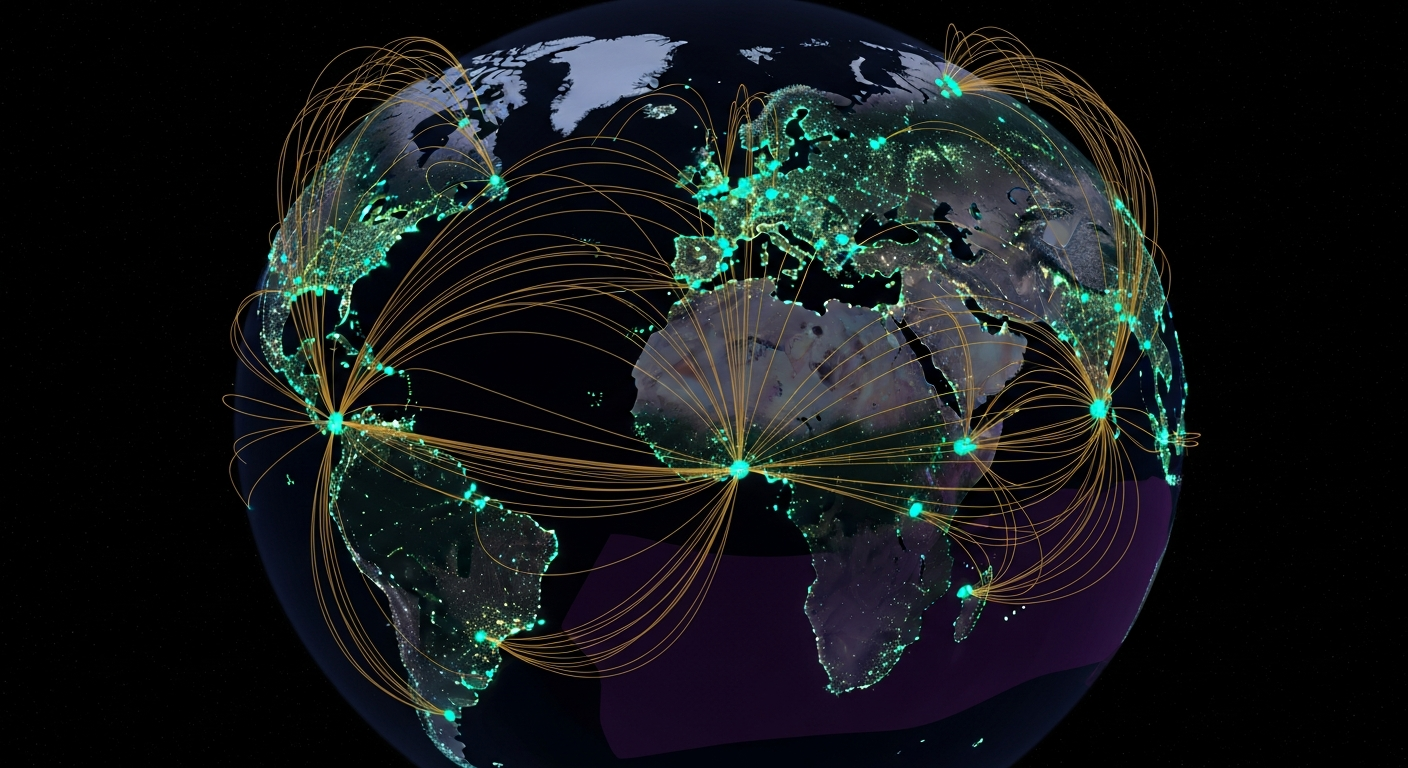
An HTTP/3 datagram path between two endpoints is not a pipe. It is a sequence of router queues, each with its own arrival distribution, drop policy, and downstream link characteristics. The end-to-end latency distribution looks nothing like a pipe's bandwidth-delay product; it looks like the convolution of a few dozen heavy-tailed queue residence-time distributions, with a thin high-velocity core (the median) and a thick low-velocity annulus (the long tail).
The standard congestion-control response is to model the path as a single pipe and to probe its capacity. BBR does this elegantly. CUBIC does it less elegantly. Both treat the boundary layer — the long tail — as noise to be averaged out.
The Schauberger reading is the opposite. The boundary layer is not noise; it is structure. The long tail of a path's latency distribution is generated by a small number of identifiable router queues that are persistently saturated, and any routing algorithm that treats those queues as part of the same statistical population as the median is going to underweight their contribution to user-visible behaviour.
Cross-Section as a Routing Heuristic
The geometric instinct that follows is not an algorithm; it is a discipline. Record, for any candidate path, not the mean latency but the cross-section — a discretized estimate of the latency distribution at p50, p90, p99, and p999. Treat the cross-section as a four-dimensional vector and route incoming traffic by matching the request's deadline budget against the vector, not against the mean.
Concretely the discipline assigns three classes:
- Bulk transfer requests (large file downloads with no deadline) are routed along paths with the highest p50 and lowest variance — the “thick annulus” paths whose tail behaviour is well-understood and whose median capacity is high.
- Interactive requests (page loads, API calls under a 200 ms budget) are routed along paths with the lowest p99 — the “tight core” paths, even where their p50 is worse.
- Real-time streams (WebRTC, gaming) are routed along paths with the lowest p999 and the most stable cross-section across a short measurement window — the “Schauberger flume” paths whose entire profile is undulating in a known waveform.

Why the Geometry Matters
The standard counterargument is that any routing decision based on tail behaviour will starve the median. The empirical answer, in every operator's published measurement series we have read, runs the other way. By segregating traffic by deadline class, the saturated queues that generate the tail of the interactive-class distribution stop receiving bulk traffic, and their tail compresses. The median of the bulk class is unchanged. The total throughput across both classes is unchanged or slightly higher.
This is the network-engineering version of what Schauberger's flume did with logs. The flow is not faster on average; it is shaped so that the cargo it cares about reaches the destination on a profile that the destination can use.
The Schauberger Lineage
Schauberger's geometric intuition — that the cross-section shape of a conduit is a tunable parameter, not a fixed assumption — transposes cleanly onto a transport-engineering problem where the cross-section is the latency distribution and the tunable parameter is the deadline-class assignment. AT 117,749 (the jet turbine, 1930) and AT 134,543 (the timber flume, 1933) together encode two distinct geometric insights, the second of which is the one this essay borrows. Callum Coats chronicles the engineering record in Living Energies; Olof Alexandersson chronicles the biographical record in Living Water.
The patent is short. The discipline it suggests is shorter. The browser-side WebAssembly transport work that anchors the team's public engineering — the VRIL Web SDK and the vril-js bindings — operates one layer above the routing-class question this essay describes, but the geometric vocabulary is the same one we use to think about it. The historical patents are in the public domain; the engineering literature on their later reception is preserved in full at the Rex Research archive for any reader who wants to study the source material directly.