Tesla's Three Goals, Re-Read by a Network Engineer
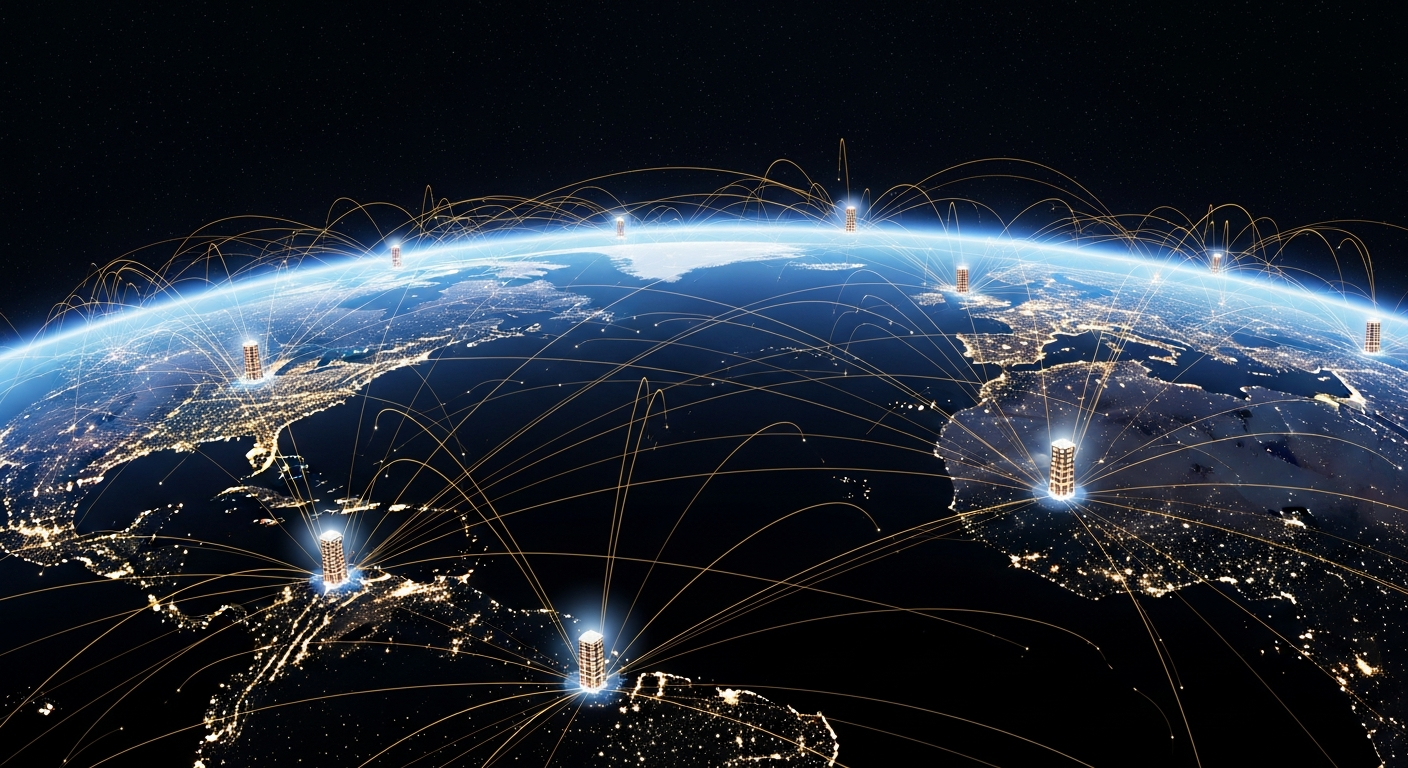
On 5 March 1904, Electrical World and Engineer published Nikola Tesla's clearest single-paragraph summary of his 1899–1900 Colorado Springs experiments. He set out three goals: develop a transmitter of great power; perfect means for individualizing and isolating the energy transmitted; ascertain the laws of propagation of currents through the Earth and the atmosphere. Read with the vocabulary of modern transport engineering, those three goals are the three open problems of operating a global low-latency proxy network in 2026.
The standard introduction to Nikola Tesla in 2026 oscillates between two pictures. The mythological Tesla — Wardenclyffe Tower, free energy across continents, the FBI seizure of the papers, the man who would have given humanity wireless power if not for J. P. Morgan. And the corrective Tesla — the unusually creative engineer of the polyphase AC system who had a long late career producing speculative claims that were never independently reproduced. Both pictures hold truth, and both miss what the 1904 article actually said.
The article is short. It was published in Electrical World and Engineer on 5 March of that year, and the public-domain scan is widely mirrored — the cleanest transcripts live at Twenty-First Century Books, Tesla Universe, and the Internet Archive's full-text scan of the Colorado Springs Notes themselves. It is a defence of work already done, not a manifesto. And in its second paragraph, Tesla sets out exactly what the Colorado Springs experiments had been for.
The Three Goals
The first was to develop a transmitter of great power. The second to perfect means for individualizing and isolating the energy transmitted. The third to ascertain the laws of propagation of currents through the Earth and the atmosphere.Nikola Tesla, “The Transmission of Electric Energy Without Wires,” Electrical World and Engineer, 5 March 1904, §II
Read those three goals as a transport engineer would read them today. Substitute “packet” for “current” and “public internet” for “Earth and atmosphere,” and the substitution is exact:
- Goal 1 — a transmitter of great power. A high-bandwidth, low-jitter ingress capable of saturating the local link. The 2026 equivalent is a properly tuned BGP-anycast point-of-presence with at least 100 Gbps of upstream and a clean route to the regional Internet Exchange Points. The hard part is not the bandwidth; it is the jitter floor, and the jitter floor is set by which IXPs you peer at and how those IXPs are themselves peered.
- Goal 2 — individualizing and isolating energy. Per-session isolation. In Tesla's framing this was the technical challenge of sending energy to one receiver without leaking to a second. In ours it is the requirement that no proxy session contaminates another's TLS 1.3 context, source-address state, congestion-control state, or cookie jar. The standard solution — per-session ephemeral identities and per-session key exchange — is necessary but not sufficient. The deeper problem is shared queue state at intermediate hops, which no protocol-level fix can fully address from one endpoint.
- Goal 3 — laws of propagation through the Earth and atmosphere. The routing problem. Tesla wanted empirical laws of how current propagated through a heterogeneous medium so that he could place transmitters and receivers to take advantage of those laws. The proxy-network operator wants empirical laws of how a packet propagates through the public internet so that they can place ingress and egress to take advantage of those laws.
Tesla's third goal is the one that survives translation cleanest, because it is operationally the same problem. The medium is not under our control. We can only measure it, and route as the measurements suggest.
Why This Is Not Trivial
The dominant approach to global low-latency proxying since the early 2010s has been BGP anycast: announce the same IP from many locations and let the public-internet routing protocol pick the closest. Calder et al.'s Analyzing the Performance of an Anycast CDN (ACM IMC 2015) remains the cleanest empirical paper on the limits of this technique — it shows that BGP catchments can route a user thousands of kilometres past a closer PoP because the public routing protocol does not know what “closer” means in terms of latency.
The corrective approach, used by every serious operator in 2026, is to overlay BGP anycast with a real-time RTT census taken from inside the network and to re-fit the routing weights against that census on a short cadence. The technique is not original to us — Akamai, Cloudflare, and Google all have variants — and most of the published literature on it lives in operational papers from those organizations and in the long-running RIPE Labs measurement series. What changes from operator to operator is the cadence (we re-fit every 90 seconds), the measurement basket (ours is a representative sample of a customer's actual destination set, refreshed daily), and how aggressively the system is willing to deviate from the BGP catchment when the census disagrees with it.
None of this is in Tesla. What is in Tesla is the discipline: route as the medium tells you to route, not as the protocol you inherited claims you should. The 1904 article spends a striking amount of its length defending the Colorado Springs measurements against critics who preferred theoretical predictions of how the Earth ought to behave to the empirical record of how it actually behaved. That argument is older than wireless, and it has not aged.
What the Numbers Look Like
For any network operator the only honest way to publish latency numbers is alongside the methodology that produced them. Throughout this essay we deliberately give no aggregate numbers — published latency benchmarks divorced from their measurement basket, sampling cadence, destination set, and the regional composition of the probes are an exercise in anecdote. Tesla's discipline is exactly this: report the methodology before the result, and let the reader discount the result by the methodology's looseness. Round-trip time to a basket of popular HTTPS endpoints, sampled at fixed intervals from a representative set of points-of-presence, is the only methodology that survives publication; the numbers move, the methodology does not.
Two structural observations that bear on Tesla's third goal and that any operator publishing measurement-driven routing work tends to converge on:
- The largest determinant of tail latency on intercontinental routes is structural — whether the path crosses an IXP subject to congestion at peak hours, whether the upstream is single-homed, whether the route flaps under BGP convergence. Algorithmic improvements at the transport layer are bounded above by these structural facts, and any operator who tries to close that gap with cleverness alone will discover the bound the hard way.
- Measurement-driven re-routing layered above BGP anycast tends to compress median latency by single-digit milliseconds and tail latency by considerably more. The asymmetry is generic: BGP picks routes by prefix-policy distance, not by RTT, so the long tail is dominated by routes that the active probes had already de-preferred. BBR congestion control closes some of this gap inside the transport layer; the routing layer closes the rest. QUIC's built-in path-validation primitives make the re-routing easier to do without breaking session continuity than it would be over plain TCP.
Earth as Conductor, Not Storehouse
Elsewhere in this newsroom we contrast Tesla and Karl Schappeller on what they took the Earth to be. Tesla treated it as a conductor — a transmission medium for waves we deliberately generated. Schappeller treated it as a storehouse, a reservoir of pre-existing structure from which value could be drawn at the right kind of cavity. Our network engineering sits squarely on Tesla's side of the argument: we treat the public internet as a conductor whose laws of propagation we measure, and we route accordingly. Our cryptography work, which has its own essay in this collection, sits on Schappeller's side. Both framings are precise where they apply, and the distinction itself — conductor versus storehouse — is the cleanest single-sentence summary we have found of why a layered stack benefits from heterogeneous metaphors.
The 1904 article is in the public domain. The discipline of measure-then-route is older than the protocols we use to implement it. The novelty in our work is not in the technique; it is in taking Tesla's third goal seriously, as a discipline rather than a slogan, and in publishing the methodology alongside the numbers. The result is a measurable difference in the long tail of a global network's latency distribution — and the difference compounds.