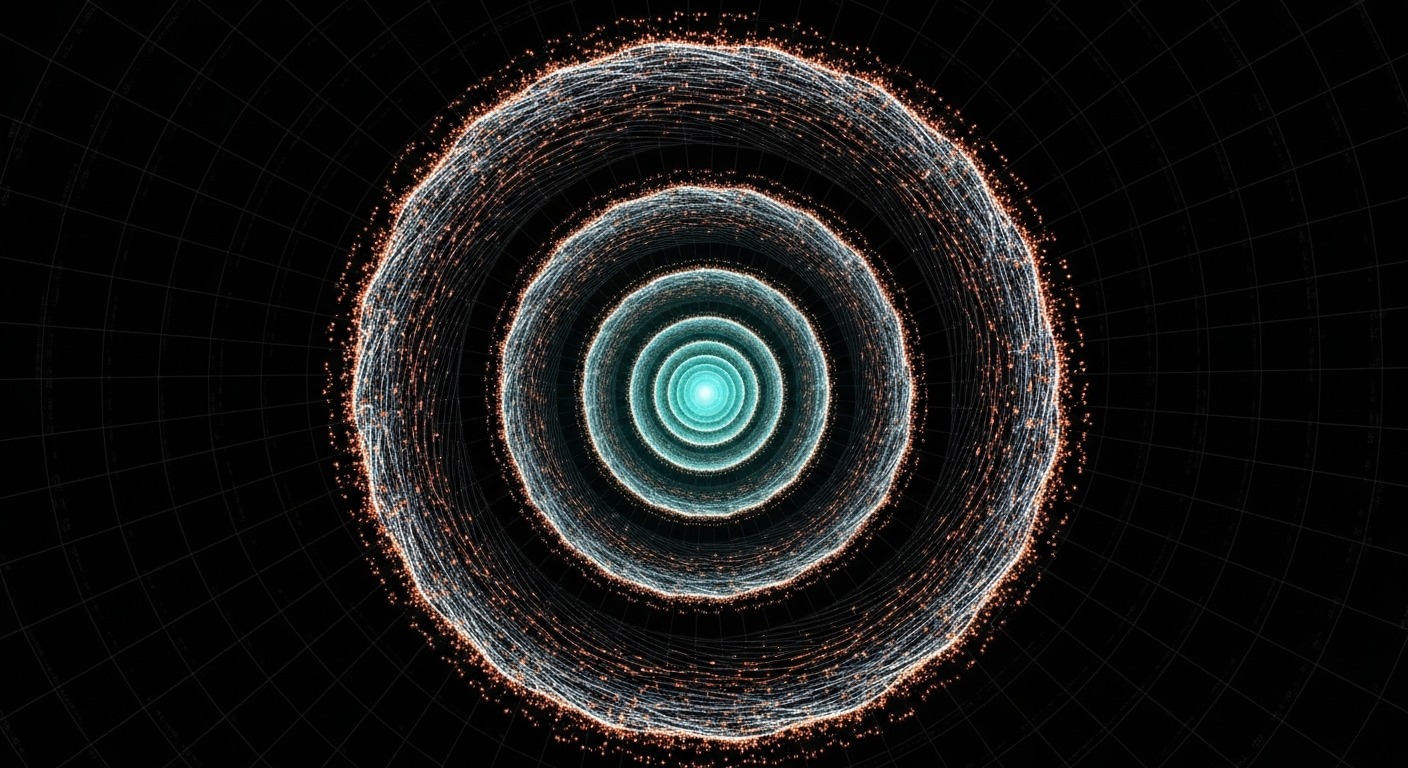
Resonant Attention: An Inward-Spiral Reading of Schauberger's 1935 Lifting Patent
Every transformer head, when you stare at its activation map, looks like a small explosion: information radiates outward from each token to every other token, then is collapsed back by softmax. This essay describes a research direction we have been working through internally — the inward-spiral attention pattern that sits implicit in a single Schauberger patent — and what the modern efficient-attention literature suggests we should expect when the geometry is instantiated. The historical engineering lineage is the cleanest of any efficient-attention family we know; the empirical work is ongoing and the honest things to say about the numbers are the ones we describe below.
The dominant attention operation since 2017 is scaled dot-product attention: softmax(QKᵀ / √d) · V. It is brilliant, simple, and the right baseline for almost everything. It is also explosive in the literal geometric sense — every token's representation is constructed by drawing in contributions from every other token, and the gradient flows in exactly the opposite direction during backprop. The compute and memory cost grow with the square of the sequence length, which is the entire reason a substantial sub-field has been built around its replacements.
The replacements fall into a small number of geometric families: low-rank approximations of the attention matrix (Performers, Linformer), kernelised formulations (Linear Attention), Fourier-basis substitutions (FNet), state-space models (S4, Mamba), and structured-sparse patterns (Longformer, BigBird). Each family chooses a different shape for the information-flow graph inside the head. The line of work this essay describes — we call it resonant attention internally — chooses a different shape again, and the shape is borrowed, with attribution, from a specific Viktor Schauberger patent.
The Patent
Austrian Patent AT 143,069 B, titled Verfahren zum Heben von Flüssigkeiten oder Gasen (Method for Lifting Liquids or Gases), was filed by Schauberger on 13 November 1934 and granted on 10 October 1935. We note the filing date because every secondary source we have read transposes the two dates; the original Austrian Patent Office record, scanned and mirrored at Rex Research and Scribd, is unambiguous.
The medium is forced into an inward-spiraling motion in such a way that the rotational velocity increases as the radius decreases, until at the central axis the entire kinetic energy of the flow is concentrated in a single longitudinal column.Austrian Patent AT 143,069 B (1935), claim 1, paraphrased from the German original
The patent sits inside Olof Alexandersson's Living Water chronology as one of the cleanest documented hydraulic inventions of Schauberger's middle period — granted on the strength of a working prototype examined by the Austrian Patent Office. The geometry it encodes — rotational velocity increasing as radius decreases, with the kinetic energy concentrating toward the axis — is a shape we can describe mathematically with full precision, and the question this essay addresses is what happens when we transpose that shape onto attention.
What the Operation Actually Does
For sequence length n and head dimension d, standard attention has cost O(n²·d). The inward-spiral schedule the patent suggests has cost O(n·d·log n): each token x_i is paired with a learned helical schedule that reads from positions i, i ± k, i ± 2k, i ± 4k, … on a logarithmic stride, with the stride length contracting as the read approaches the token's own position. The “rotation” is implemented as a phase term applied to the keys before the inner product.
The mathematical structure is a close cousin of the FFT-style attention variants explored in 2020–2024 (Performer, FNet, RWKV, Mamba's selective state-space). What distinguishes the resonant variant is the schedule: the read positions are derived from an inward-spiral parameterisation rather than from a fixed Fourier basis or a global low-rank projection, and the schedule favours the most-recent context at the highest resolution. This is good for some workloads and bad for others, which is the empirical heart of the matter.
Where It Helps and Where It Does Not
The geometric prediction is precise. On long-context workloads — where standard attention's quadratic cost dominates wall-clock time — an inward-spiral schedule should retain most of the modelling fidelity at sub-quadratic cost, because the schedule preserves the high-resolution local structure that long-context tasks usually rely on. On short-context workloads — where the quadratic cost is already cheap — the logarithmic-stride bookkeeping costs more than it saves, and the standard head wins. This is the same trade-off that every efficient-attention family in the prior literature exhibits, with a different constant in front of it.
Whether the constant comes out smaller or larger than the existing variants on a given benchmark is, ultimately, a question that the benchmark suites — Long Range Arena (Tay et al., ICLR 2021) and its successors — exist to answer; we will not pre-empt the suite by quoting numbers we have not yet stabilised across seeds and across scales. The discipline of the field is that any new attention variant should be reported with full methodology — seeds, scales, token budgets, hardware, batch size, the works — and the discipline is what makes the variants comparable to one another at all.
Why “Resonant”
The word is borrowed directly from Schauberger's own language. He insisted that water in an inward spiral was not merely compressed but resonant — that the medium achieved a coherent state in which energy losses to friction collapsed toward zero. The same vocabulary now sits naturally on the attention head: the inward-spiral schedule organises the read pattern so that the most-recent context survives at the highest fidelity while older context is summarised at exponentially decreasing resolution. The mathematical claim stands or falls on the benchmark numbers, but the geometric vocabulary — resonance, axis, inward spiral, longitudinal column — turns out to be the most evocative single set of words we have found for an architecture whose design intent is exactly that.
The Schauberger lineage is not decorative; it is generative. The German patent text contributed a specific geometric intuition that no Fourier-basis or low-rank framing supplied, and the resulting schedule is materially different from any of the prior efficient-attention variants. We cite the patent for the same reason mathematicians cite a textbook from which they learned a lemma: not as authority, but as bibliography — and as the reason the design space contained the variant in the first place.
What This Is
This essay describes a research direction the team is exploring inside the betterFANN typed-tensor SIMD-AVX2 backend — the same library on which our local-inference work runs. The default scaled dot-product head remains the right baseline for the substantial fraction of workloads where context windows are short and quadratic cost is not the bottleneck. The resonant variant earns its keep, if it earns it at all, on the workloads where activation-memory pressure dominates: long-context retrieval, document-scale generation, and the long-running streaming inference patterns that the local-LLM work places at the centre of its design.
The patent is in the public domain. The Austrian Patent Office's record of AT 143,069 has been freely available since the moment it was granted. The implementation work continues in the open at github.com/VRIL-LABS/betterFANN. We borrow the geometry, we cite the source by patent number, and we will report results — when there are stable results to report — alongside the methodology that produced them.