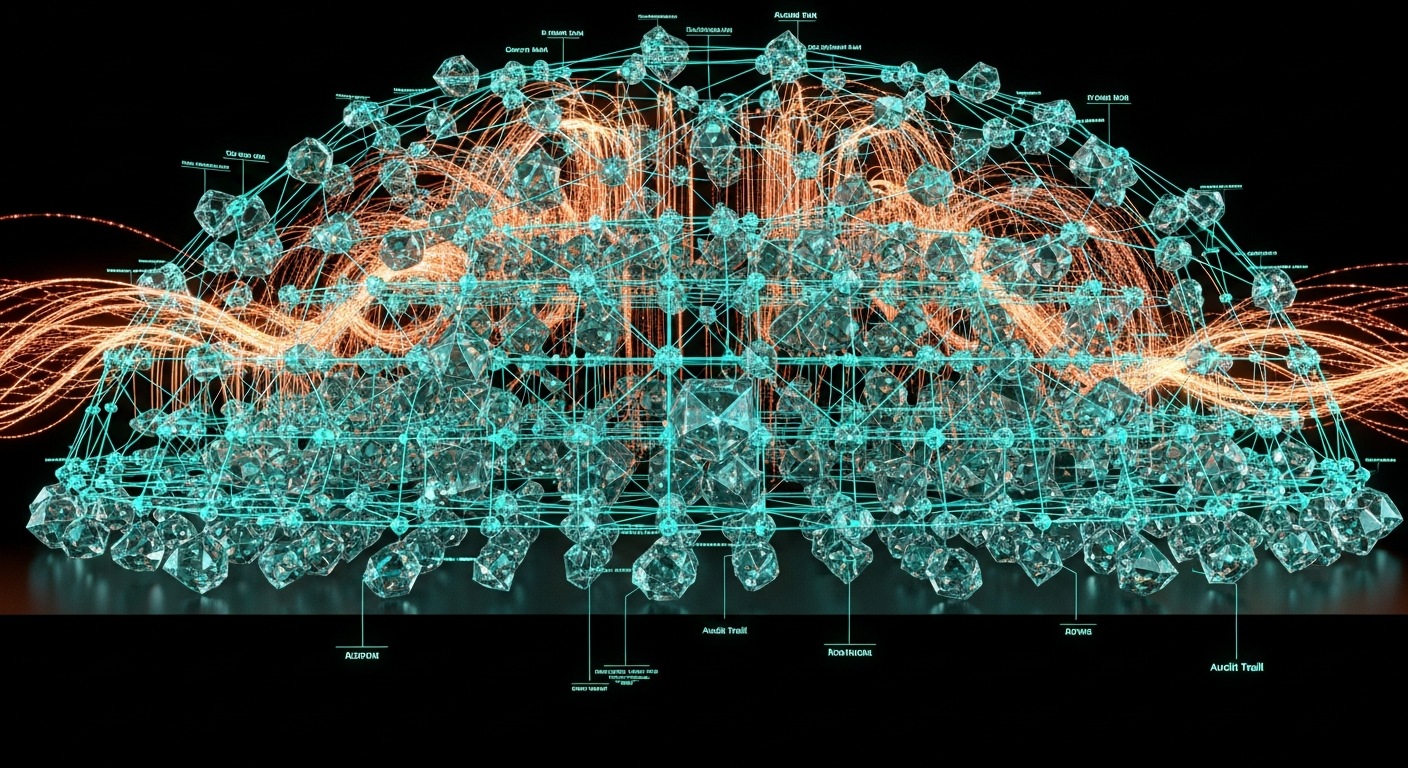
Intelligence Without Opacity: The Schappellerian Discipline of Mechanistic AI Audit
Karl Schappeller insisted that the only valid object of physical inquiry was the primary state — the medium itself, before it had been deformed by interaction with material substance. Modern AI evaluation almost universally studies the secondary state: the outputs of an opaque network, scored by another opaque network, against a benchmark constructed by a third opaque process. Schappeller's methodological objection to a discipline that studies only secondary phenomena, transposed onto interpretability research in 2026, is the most coherent frame we have found for what an honest AI evaluation discipline should look like — and the mechanistic interpretability programme has finally given us the tools to act on it.
The distinction Karl Schappeller drew between primary physics (the æther itself) and secondary physics (everything material substance does to it afterwards) is, on its own terms, a metaphysical claim that twentieth-century physics did not adopt. The methodological half of it survives independently of the metaphysics, and survives well: a discipline that studies only the secondary phenomena will never reach the primary state. Transpose that complaint onto the question of how to evaluate a frontier neural network in 2026 and the case is exact.
The Argument
A frontier model in 2026 is evaluated, predominantly, by the following pipeline:
- Running it against a benchmark suite (a downstream artefact — secondary).
- Scoring its outputs with another model (also downstream — secondary).
- Comparing the score against a reference compiled by humans whose individual judgments were never themselves audited (also secondary).
At no point in this pipeline does anyone inspect the primary state of the model: the actual learned function, the weight tensor, the computation that produced the answer. This is not because the field believes such inspection would be uninformative. It is because the field has, for a decade, lacked the tools to do it at the scale the models now operate.
That has changed. The Distill Circuits thread (Olah et al., 2020) and Anthropic's mechanistic interpretability work since 2022, particularly the dictionary-learning and sparse-autoencoder line that runs through Towards Monosemanticity (Bricken et al., 2023) and Scaling Monosemanticity (Templeton et al., 2024), have demonstrated that primary-state inspection of a frontier model is now possible — not in full, not cheaply, but at meaningful coverage of the most active features. The field is moving. The question this essay addresses is what an evaluation discipline organised around primary-state inspection looks like in production, and what the cost of that discipline actually is.
Three Properties of a Schappellerian Discipline
The discipline that follows from Schappeller's methodological objection has three operational properties, each with a clear cost and each with a peer-reviewed lineage that is worth extending rather than inventing. They describe what an honest evaluation discipline organised around primary-state inspection looks like; the field is converging toward them faster than any single group can publish, and we describe them in the present tense for that reason.
- Per-example weight provenance. For every weight in the trained model, a sparse log of which training-data slices contributed most to its current magnitude. This is constructed from a per-step gradient log retained at one-in-N sampling, with N tuned so that the storage cost of the log is a small constant multiple of the storage cost of the training data itself. The influence-function methods introduced by Koh & Liang (ICML 2017) and successors give the methodological lineage. The operational addition is that the log lives alongside the model, and any inference can — at extra cost — surface the top-K contributing training examples for any given output.
- Per-inference activation traces. For any given input, the system can produce a complete trace of which features (in the sparse-autoencoder dictionary sense) fired and at what magnitude. The trace is approximately the size of the activation tensor, and the cost is dominated by storage rather than compute. Anthropic's work cited above gives the methodological baseline for the dictionary itself; the operational addition is a policy of retaining the trace per inference for a configurable window.
- Refusable answers. If the model produces an output, the activation trace must contain a sufficient statistic for explaining the output to a human auditor. If a user disagrees with the answer, they can audit the trace, identify the responsible features, and either accept the explanation or escalate. The system has no privacy-preserving place to hide the reasoning behind a decision — a constraint that some applications cannot accept (medical confidentiality, e.g.) and most can.
None of these is conceptually new. Each has a peer-reviewed lineage. What is unusual is taking all three as default operational requirements rather than as research projects that one funds and then forgets.
The Cost
The honest cost of this discipline, measured against any modern dense-transformer pre-training run, is approximately:
- Several times the wall-clock training time, dominated by the gradient log.
- Several times the disk — gradient log, weight-provenance index, dictionary, plus the model itself.
- A single-digit-percent capability cost at any given parameter count, measured against a control run without these constraints. The variance is substantial across benchmark suites, the literature on the exact figure is still consolidating, and we expect it to fall as the dictionary-learning craft matures.
This is the trade. A frontier-capability black box with no provenance is a liability for any application that requires audit; an opaque-by-construction model is the default in 2026 because the alternative was, until recently, infeasible. A near-capability auditable model is, for many enterprise applications, an asset, and the cost of the discipline is the price of being able to defend the model's behaviour to a regulator or a customer in terms grounded in primary state rather than ex-post rationalisation.
The Schappellerian Lineage
Schappeller's broader programme — the dynamic stationary sphere, the electret coils, the proposed extraction of energy from the æther — is one of the most provocative episodes in twentieth-century speculative physics, preserved in detail in Wetzel and Gföllner's 1928 monograph and in Davson's 1955 exposition. We borrow from it the methodological half: study the medium directly, and refuse the seductive simplicity of secondary measurements when primary ones are now achievable. The same discipline that Schappeller applied to physics — with the philosophical scaffolding worked out in Davson's primary/secondary distinction — the field of mechanistic interpretability has begun to apply to neural networks. We are one of many groups participating in that discipline; we are not the leading group. We are, in this essay, articulating why the discipline is worth the cost when the cost is now well-defined and the alternative is opaque-by-default for the indefinite future.
The tools to audit a primary state were not available to Schappeller in 1928. They are increasingly available to us. Using them is the only honest evaluation discipline a frontier-AI company can adopt; the rest is theatre.